NEB Mathematics notes on derivatives and limits with formulas, first principle, product rule, quotient rule, chain rule, and solved examples.
Limits and derivatives are central topics in calculus. A limit describes the value a function approaches, while a derivative measures the rate of change of a function. Together, they help us study curves, motion, slopes, optimization, and many real-life changes.
In NEB Mathematics, derivatives appear in both short and long questions. Students are often asked to evaluate limits, differentiate using first principle, apply standard formulas, and solve problems using product, quotient, or chain rule.
This guide explains the ideas in simple language and gives exam-focused steps. The goal is not just to memorize formulas, but to know when and how to use each rule.
A limit tells us what value a function approaches when the input approaches a particular number. The function may or may not actually take that value at the point.
Limits are used to define continuity, derivatives, and many advanced calculus concepts. In exams, direct substitution, factorization, rationalization, and standard limits are common methods.
Exam Focus
A derivative is the limiting value of the average rate of change. Learn the concept first, then apply formulas for speed.
1. Meaning of Limits
- Direct substitution works if it gives a defined value.
- Factorization helps remove common zero factors.
- Rationalization is useful with square roots.
- Standard limits should be memorized.
- A limit may exist even if the function is not defined at the point.
2. Meaning of Derivative
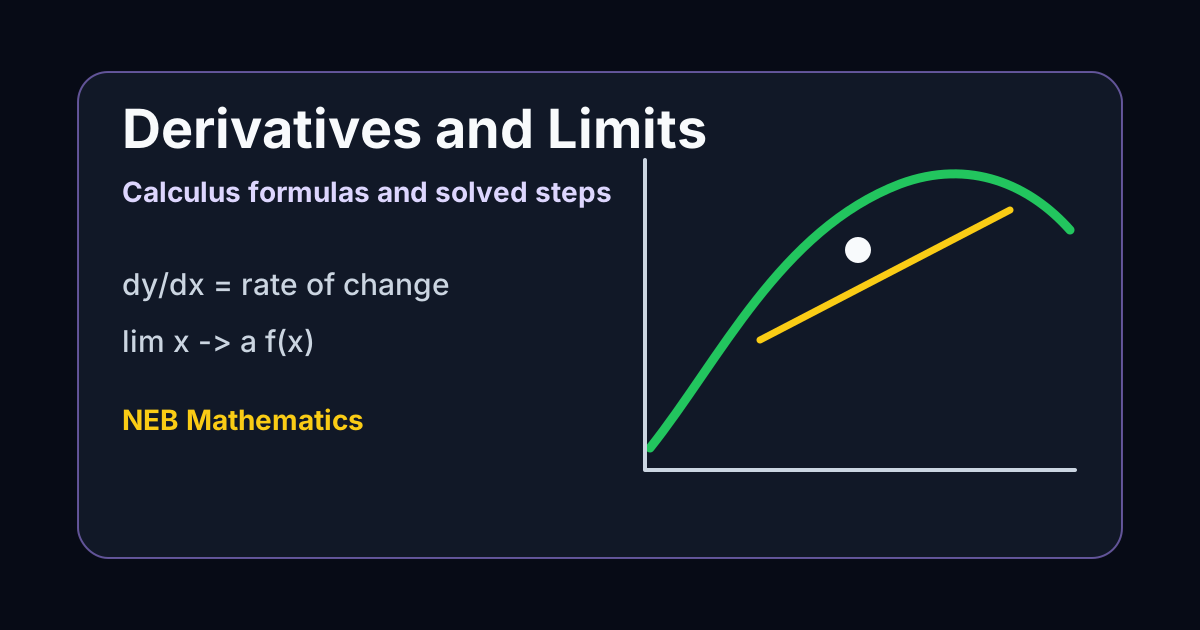
A derivative measures how fast a function changes with respect to its variable. Geometrically, it represents the slope of the tangent to a curve at a point.
If y = f(x), the derivative is written as dy/dx or f'(x). A positive derivative means the function is increasing, while a negative derivative means it is decreasing.
- Derivative is rate of change.
- It gives slope of tangent.
- It can be found from first principle.
- It is used in velocity, acceleration, and optimization.
- Notation must be written correctly.
3. Basic Rules of Differentiation
Once the concept is clear, formulas make differentiation faster. The power rule, constant rule, sum rule, product rule, quotient rule, and chain rule are the most important.
The chain rule is especially important when one function is inside another function. For example, differentiating (3x + 2)^5 requires differentiating the outside power and multiplying by the derivative of the inside expression.
d(x^n)/dx = nx^(n-1)- Derivative of a constant is zero.
- Derivative of
sin x is cos x.
- Derivative of
cos x is -sin x.
- Use product rule when two functions are multiplied.
- Use quotient rule when one function is divided by another.
4. Applications of Derivatives
Derivatives are used to find slope, velocity, acceleration, maximum and minimum values, and approximate changes. In Economics, derivatives are used for marginal cost and marginal revenue.
For school-level exams, applications usually include tangent and normal, increasing and decreasing functions, maxima and minima, and motion in a straight line.
- Slope of tangent is
dy/dx.
- Velocity is derivative of displacement.
- Acceleration is derivative of velocity.
- Critical points occur when derivative is zero or undefined.
- Second derivative helps test maxima and minima.
Solved Example: Differentiation
Question: Differentiate y = 3x^4 - 5x^2 + 7x - 9 with respect to x.
- Use the power rule for each term separately.
- Derivative of
3x^4 is 12x^3.
- Derivative of
-5x^2 is -10x.
- Derivative of
7x is 7, and derivative of -9 is zero.
Answer: dy/dx = 12x^3 - 10x + 7.
Common Mistakes Students Should Avoid
Most students lose marks in this topic not because the chapter is impossible, but because they write incomplete definitions, skip the reasoning step, or present the answer without a proper structure. The following mistakes are easy to avoid if you revise with a checklist.
- Forgetting to write
lim in intermediate limit steps.
- Dropping the negative sign while differentiating cosine.
- Using product rule where chain rule is needed.
- Forgetting derivative of constant is zero.
- Not simplifying the final answer.
A strong board-exam answer should move from definition to explanation, then to example, formula, diagram, table, or application depending on the subject. Avoid writing a single large paragraph. Use headings, underline important terms, and keep every calculation or argument connected to the question asked.
- Memorize standard derivative formulas.
- Practice first-principle derivation for common functions.
- Identify the rule before solving.
- Show each step in long questions.
- Check signs carefully, especially in trigonometric derivatives.
Practice Questions for Revision
Use these questions after reading the guide. First try answering without looking at the explanation, then compare your answer with the structure above. This method builds recall and improves exam presentation.
- Evaluate a limit using factorization.
- Differentiate
x^5 + 2x^3 - 4x.
- Find derivative of
(2x + 1)^6.
- Use product rule to differentiate
x^2 sin x.
- Find slope of tangent to a curve at a given point.
Frequently Asked Questions
What is the difference between limit and derivative?
A limit shows the value approached by a function, while a derivative uses limits to measure rate of change.
Which differentiation rule is most important?
The power rule is most basic, but product, quotient, and chain rules are essential for exam questions.
Why is first principle important?
First principle shows the original definition of derivative and is often asked as a proof-type question.
Conclusion
Limits and derivatives become easier when you learn the concept before formulas. A derivative is not just a symbol; it is the rate at which one quantity changes with another.
For strong exam performance, practice standard limits, first principle, and all differentiation rules. Clear steps and correct notation can make a big difference in marks.