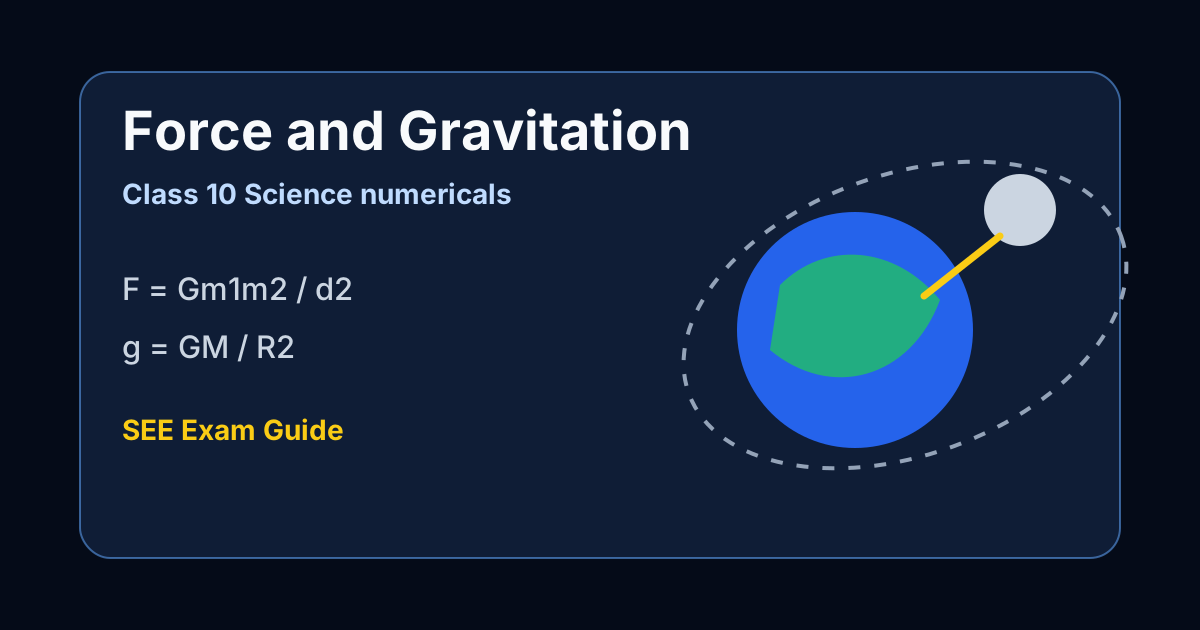
SEE Class 10 Science force and gravitation notes with Newton's law of gravitation, difference between G and g, formulas, and solved numericals.
Force and Gravitation is one of the most important units in Class 10 Science. It explains why objects fall toward Earth, why planets revolve around the sun, and how mass and distance affect attraction between bodies.
This chapter includes both conceptual questions and numerical problems. Students must understand Newton's universal law of gravitation, gravitational constant G, acceleration due to gravity g, weight, free fall, and the difference between gravity and gravitation.
The formulas are not difficult, but units and conversions are very important. Radius may be given in kilometers and must be converted into meters before calculation. This guide explains the concepts and exam method step by step.
Force is an external agency that changes or tends to change the state of rest or uniform motion of a body. It can also change the shape, size, or direction of motion of an object.
Exam Focus
Use SI units in every gravitation numerical. Convert kilometers to meters and write the formula before substituting values.
1. Meaning of Force
The SI unit of force is newton. According to Newton's second law, force is equal to mass multiplied by acceleration, or F = ma.
- Force can start motion.
- Force can stop motion.
- Force can change direction.
- Force can change speed.
- Force can change shape.
2. Newton's Universal Law of Gravitation
Newton's universal law of gravitation states that every object in the universe attracts every other object with a force directly proportional to the product of their masses and inversely proportional to the square of the distance between their centers.
The formula is F = Gm1m2 / d2, where G is the universal gravitational constant, m1 and m2 are masses, and d is the distance between their centers.
- Greater mass produces greater gravitational force.
- Greater distance produces smaller gravitational force.
- The force acts along the line joining the centers.
- The value of G is
6.67 x 10^-11 Nm2/kg2.
- Gravitation exists between all objects.
3. Gravity and Acceleration Due to Gravity
Gravity is the force with which a heavenly body attracts objects toward its center. The Earth's gravity pulls objects downward and gives them acceleration.
Acceleration due to gravity is denoted by g. Near the surface of Earth, its average value is about 9.8 m/s2. The formula is g = GM / R2, where M is mass of Earth and R is radius of Earth.
- G is universal constant.
- g changes from place to place.
- g is less on the moon than on Earth.
- Weight depends on g.
- Mass remains constant everywhere.
4. Weight, Free Fall, and Weightlessness
Weight is the force with which a body is attracted by Earth or another heavenly body. It is calculated by W = mg. Since g changes, weight can change from place to place.
Free fall is the motion of a body under the influence of gravity alone. During free fall, air resistance is neglected. Weightlessness is the condition when a body experiences zero apparent weight.
- Mass is measured in kilogram.
- Weight is measured in newton.
- Free fall acceleration is g.
- Weight on moon is about one-sixth of weight on Earth.
- Astronauts feel weightless due to continuous free fall.
Solved Example: Calculating g on Earth
Question: Mass of Earth is 6 x 10^24 kg and radius is 6400 km. Calculate g. Given G = 6.67 x 10^-11 Nm2/kg2.
- Convert radius:
6400 km = 6.4 x 10^6 m.
- Use formula:
g = GM / R2.
- Substitute values:
g = (6.67 x 10^-11 x 6 x 10^24) / (6.4 x 10^6)^2.
- Calculate to get approximately
9.8 m/s2.
Answer: The acceleration due to gravity on Earth's surface is approximately 9.8 m/s2.
Common Mistakes Students Should Avoid
Most students lose marks in this topic not because the chapter is impossible, but because they write incomplete definitions, skip the reasoning step, or present the answer without a proper structure. The following mistakes are easy to avoid if you revise with a checklist.
- Using radius in kilometers without converting to meters.
- Confusing G and g.
- Writing mass and weight as the same quantity.
- Forgetting square on distance in the gravitation formula.
- Not writing units in the final answer.
A strong board-exam answer should move from definition to explanation, then to example, formula, diagram, table, or application depending on the subject. Avoid writing a single large paragraph. Use headings, underline important terms, and keep every calculation or argument connected to the question asked.
- Memorize formulas
F = Gm1m2/d2, g = GM/R2, and W = mg.
- Write given values before calculation.
- Convert units into SI.
- Explain differences between mass and weight in a table.
- Practice at least five numerical problems.
Practice Questions for Revision
Use these questions after reading the guide. First try answering without looking at the explanation, then compare your answer with the structure above. This method builds recall and improves exam presentation.
- State Newton's universal law of gravitation.
- Differentiate G and g.
- Why is weight less on the moon?
- Calculate weight of a 50 kg body on Earth.
- Why does gravitational force decrease with distance?
Frequently Asked Questions
What is the value of G?
The value of universal gravitational constant G is 6.67 x 10^-11 Nm2/kg2.
What is the value of g on Earth?
The average value of g near Earth's surface is about 9.8 m/s2.
Does mass change on the moon?
No. Mass remains constant, but weight decreases because the value of g is smaller on the moon.
Conclusion
Force and Gravitation connects everyday falling objects with the motion of planets and satellites. Understanding formulas and units makes the chapter much easier.
For SEE exams, focus on definitions, formula meanings, differences between G and g, and numerical steps. Clean unit conversion is the key to full marks.