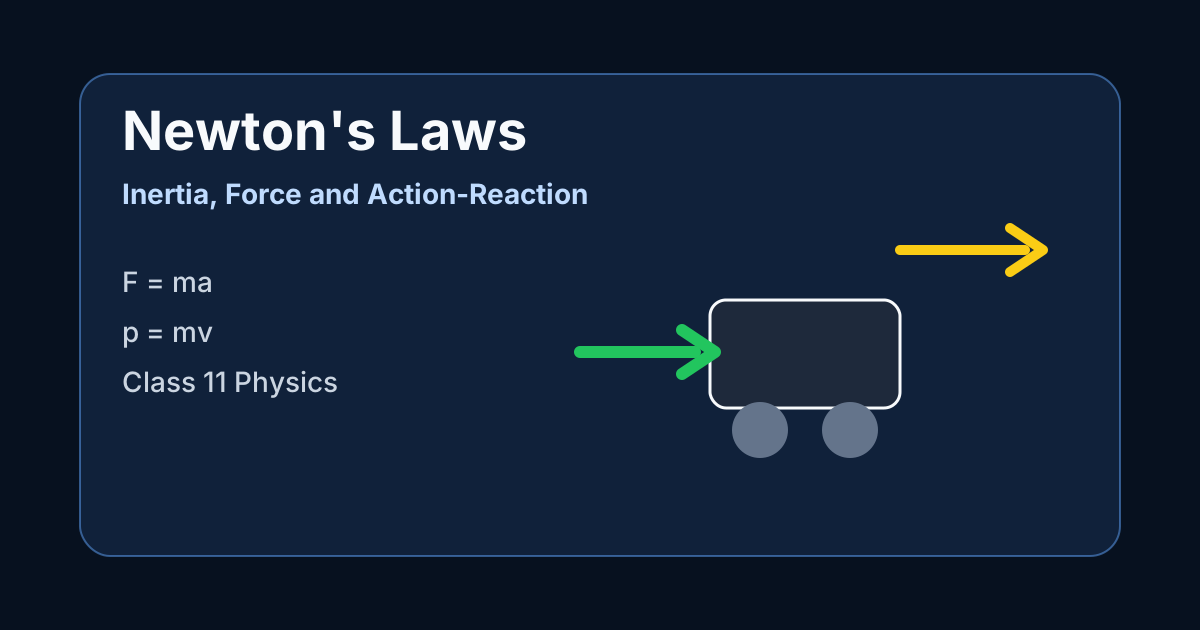
Class 11 Physics Newton's laws of motion complete notes with inertia, momentum, F = ma derivation, action reaction, and solved examples.
Newton's Laws of Motion are the foundation of classical mechanics. They explain how objects move, why they remain at rest, how force changes motion, and why every interaction produces equal and opposite effects.
These laws are not only theoretical. They explain daily experiences such as passengers moving forward when a bus stops suddenly, a ball accelerating when kicked, and recoil of a gun. In Physics exams, Newton's laws are connected with force, momentum, acceleration, friction, and free body diagrams.
For Class 11 students, the key is to understand the language of each law and apply it to numerical problems. Memorizing statements is not enough; you must know how to connect force, mass, acceleration, and momentum.
Newton's first law states that a body remains at rest or in uniform motion in a straight line unless an external force acts on it. This law is also called the law of inertia.
Exam Focus
Newton's second law gives the working formula F = ma, but the first and third laws are equally important for conceptual questions.
1. Newton's First Law and Inertia
Inertia is the property of a body by which it resists a change in its state of rest or motion. A heavier body has more inertia because it requires more force to change its motion.
- A resting object remains at rest without external force.
- A moving object continues uniform motion without external force.
- Inertia depends on mass.
- The law defines force qualitatively.
- Seat belts protect passengers from inertia during sudden stops.
2. Newton's Second Law and Force
Newton's second law states that the rate of change of momentum of a body is directly proportional to the applied force and takes place in the direction of the force.
If mass is constant, momentum is p = mv. The change of velocity per unit time is acceleration. Therefore, the law gives F = ma. This equation is one of the most used formulas in Physics.
- Momentum is the product of mass and velocity.
- Force changes momentum.
- For constant mass,
F = ma.
- The SI unit of force is newton.
- One newton is the force needed to produce acceleration of 1 m/s2 in a 1 kg mass.
3. Newton's Third Law
Newton's third law states that for every action, there is an equal and opposite reaction. The two forces are equal in magnitude, opposite in direction, and act on different bodies.
A common mistake is thinking action and reaction cancel each other. They do not cancel because they act on different objects. For example, when you walk, your foot pushes the ground backward, and the ground pushes you forward.
- Action and reaction are equal in magnitude.
- They are opposite in direction.
- They act on different bodies.
- Rocket motion is based on this law.
- Walking, swimming, and recoil are common examples.
4. Applications and Free Body Diagrams
Newton's laws are applied through free body diagrams. A free body diagram shows all forces acting on a selected object. It helps students decide which equation to use.
In problems involving horizontal motion, inclined planes, pulleys, or friction, draw the diagram first. Mark weight, normal reaction, applied force, tension, and friction. Then choose the direction of acceleration and write equations.
- Always draw forces from the body, not into empty space.
- Weight acts vertically downward.
- Normal reaction acts perpendicular to the surface.
- Friction opposes relative motion.
- Tension acts along the string.
Solved Example: Force and Acceleration
Question: A force of 20 N acts on a body of mass 5 kg. Calculate the acceleration produced.
- Write the given values: force F = 20 N and mass m = 5 kg.
- Use Newton's second law:
F = ma.
- Rearrange the formula:
a = F / m.
- Substitute values:
a = 20 / 5 = 4 m/s2.
Answer: The acceleration of the body is 4 m/s2.
Common Mistakes Students Should Avoid
Most students lose marks in this topic not because the chapter is impossible, but because they write incomplete definitions, skip the reasoning step, or present the answer without a proper structure. The following mistakes are easy to avoid if you revise with a checklist.
- Writing action and reaction on the same body.
- Forgetting units in numerical answers.
- Using weight as mass without converting using
W = mg.
- Skipping the free body diagram in force problems.
- Confusing velocity and acceleration.
A strong board-exam answer should move from definition to explanation, then to example, formula, diagram, table, or application depending on the subject. Avoid writing a single large paragraph. Use headings, underline important terms, and keep every calculation or argument connected to the question asked.
- Write all three laws in accurate language.
- Explain inertia with a daily-life example.
- Derive
F = ma from momentum.
- Draw free body diagrams for numerical problems.
- Mention units of force, mass, and acceleration.
Practice Questions for Revision
Use these questions after reading the guide. First try answering without looking at the explanation, then compare your answer with the structure above. This method builds recall and improves exam presentation.
- State and explain Newton's first law of motion.
- Derive
F = ma from Newton's second law.
- Why do action and reaction not cancel each other?
- Explain recoil of a gun using Newton's third law.
- Solve a numerical problem using force, mass, and acceleration.
Frequently Asked Questions
Which law defines force?
Newton's first law gives a qualitative definition of force as an external agency that changes or tries to change the state of rest or motion.
Which law gives the formula F = ma?
Newton's second law gives the formula F = ma when mass is constant.
Why do passengers jerk forward when a bus stops?
Due to inertia of motion, the upper body continues moving forward even when the bus stops suddenly.
Conclusion
Newton's laws explain the connection between force and motion. They are essential for understanding mechanics, from simple daily examples to advanced numerical problems.
For exams, combine accurate statements, diagrams, formulas, and examples. This approach makes your answer complete and helps you avoid common conceptual mistakes.