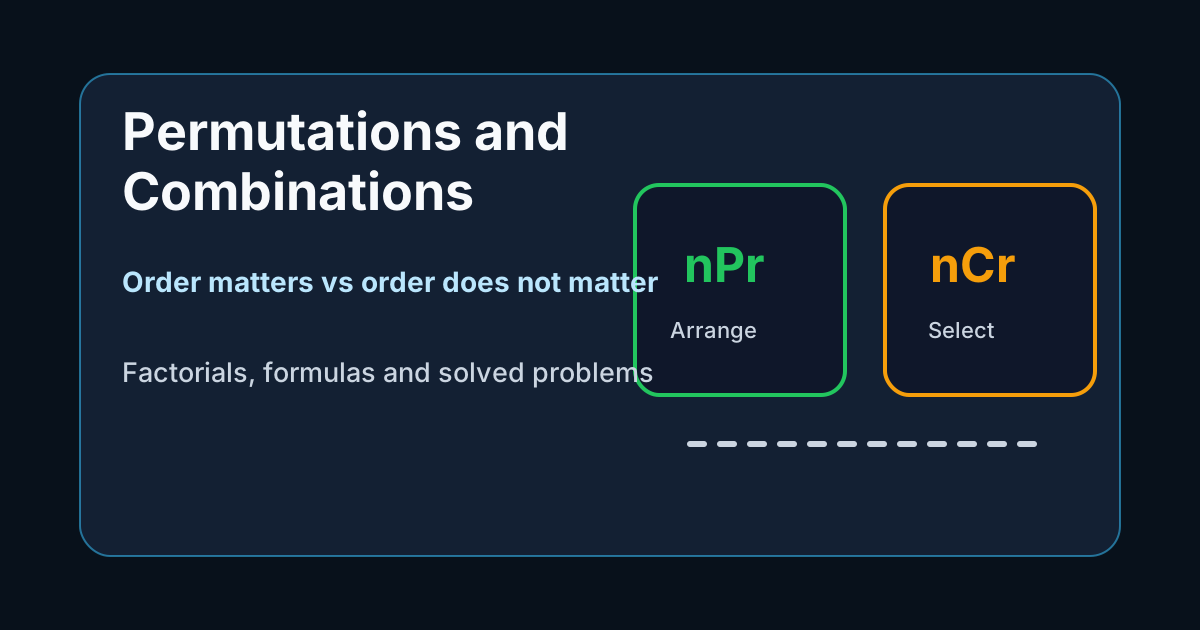
NEB Mathematics permutations and combinations guide with factorials, nPr, nCr, differences, solved examples, and exam tips.
Permutations and Combinations are counting techniques used when listing every possible outcome one by one is difficult. They help us count arrangements, selections, teams, codes, rankings, and groups quickly.
The most important difference is order. If order matters, the problem is related to permutation. If order does not matter, the problem is related to combination. Most mistakes in this chapter happen because students do not identify this difference.
For NEB Mathematics, this topic is scoring if you understand factorial notation, the formulas nPr and nCr, and the words used in questions such as arrange, select, choose, committee, rank, and position.
Factorial means the product of all positive integers from a number down to 1. It is written using the symbol !. For example, 5! = 5 x 4 x 3 x 2 x 1 = 120.
Factorials are used in both permutation and combination formulas. By definition, 0! = 1. This value is important in formulas when all objects are selected.
Exam Focus
Ask one question before applying any formula: does order matter? If yes, use permutation. If no, use combination.
1. Factorial Concept
n! = n x (n - 1) x ... x 11! = 10! = 1- Factorials grow very quickly.
- Cancel factorials before multiplying large numbers.
2. Permutation: When Order Matters
A permutation is an arrangement of objects in a definite order. If changing the order changes the result, the problem is about permutation.
Examples include arranging books on a shelf, forming number codes, ranking students, assigning positions, or selecting president and secretary from a group.
nPr = n! / (n - r)!- Used for arrangements and positions.
- Order changes the result.
- Ranking is a permutation problem.
- Codes and passwords usually use permutation.
3. Combination: When Order Does Not Matter
A combination is a selection of objects where order is not important. If the same group remains the same even after changing order, the problem is about combination.
Examples include forming a committee, selecting players for a team, choosing questions to attempt, or selecting fruits from a basket.
nCr = n! / [r!(n - r)!]- Used for selection and grouping.
- Order does not change the result.
- Committee formation is a combination problem.
- Combination values are usually smaller than permutation values.
4. How to Identify the Correct Formula
Read the wording carefully. Words like arrange, rank, position, password, order, and seat usually indicate permutation. Words like choose, select, committee, group, and team usually indicate combination.
Some questions include restrictions, such as exactly two girls, at least one science student, or no repetition. Break these questions into cases and apply the multiplication or addition rule as needed.
- Arrangement means permutation.
- Selection means combination.
- Use multiplication rule when tasks happen together.
- Use addition rule when cases are separate alternatives.
- Check whether repetition is allowed.
Solved Example: Committee Formation
Question: In how many ways can a committee of 5 members be formed from 6 men and 4 women such that it contains exactly 3 men and 2 women?
- Committee formation is selection, so use combination.
- Select 3 men from 6:
6C3 = 20.
- Select 2 women from 4:
4C2 = 6.
- Both selections must happen together, so multiply:
20 x 6 = 120.
Answer: The committee can be formed in 120 ways.
Common Mistakes Students Should Avoid
Most students lose marks in this topic not because the chapter is impossible, but because they write incomplete definitions, skip the reasoning step, or present the answer without a proper structure. The following mistakes are easy to avoid if you revise with a checklist.
- Using permutation for every counting problem.
- Forgetting to divide by
r! in combination.
- Not checking whether repetition is allowed.
- Adding cases that should be multiplied.
- Ignoring words like exactly, at least, and at most.
A strong board-exam answer should move from definition to explanation, then to example, formula, diagram, table, or application depending on the subject. Avoid writing a single large paragraph. Use headings, underline important terms, and keep every calculation or argument connected to the question asked.
- Underline keywords in the question.
- Write whether it is permutation or combination before solving.
- Use factorial cancellation to simplify calculations.
- Separate restricted cases clearly.
- Write final answer with words such as ways, arrangements, or selections.
Practice Questions for Revision
Use these questions after reading the guide. First try answering without looking at the explanation, then compare your answer with the structure above. This method builds recall and improves exam presentation.
- How many ways can 4 books be arranged on a shelf?
- How many teams of 3 can be selected from 10 students?
- How many 3-digit numbers can be formed without repetition?
- How many committees of 4 include exactly 2 boys and 2 girls?
- Differentiate permutation and combination with examples.
Frequently Asked Questions
What is the main difference between permutation and combination?
In permutation, order matters. In combination, order does not matter.
Is selecting a committee permutation or combination?
It is combination because the order of selected members does not change the committee.
Is ranking students permutation or combination?
It is permutation because first, second, and third positions are different.
Conclusion
Permutations and combinations become simple when you understand the meaning of order. Do not rush to formulas before reading the question carefully.
With regular practice, you can quickly identify the type of problem, apply the correct formula, and solve counting questions accurately in exams.