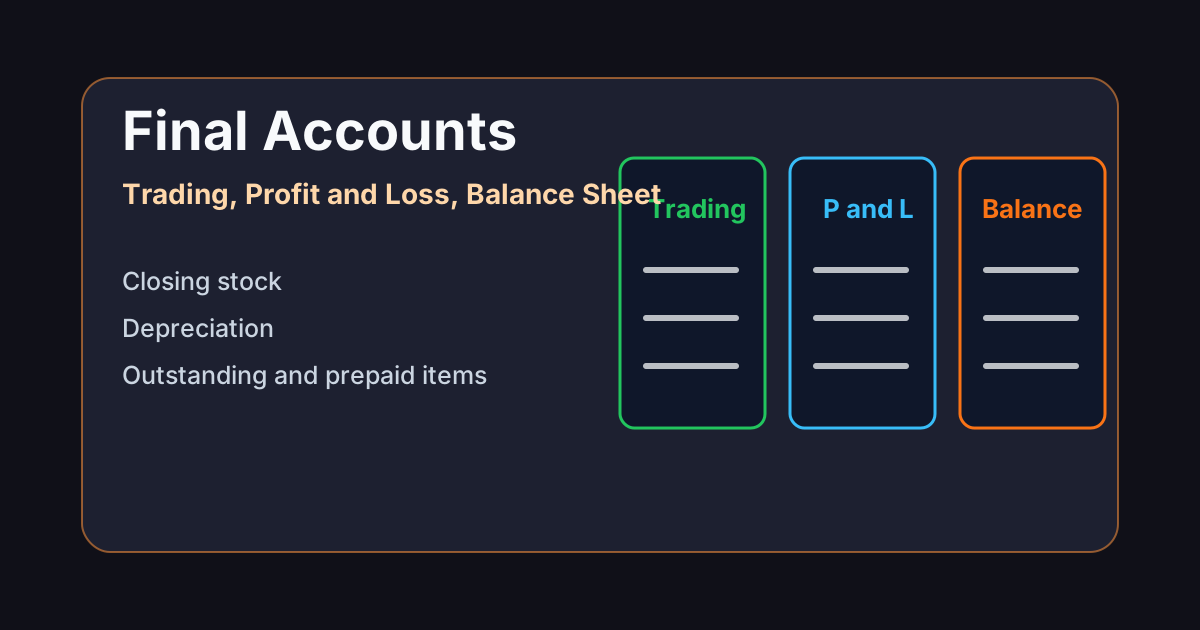
Learn final accounts preparation for Class 12 Accountancy: Trading Account, Profit and Loss Account, Balance Sheet, and common adjustments.
Final Accounts are prepared at the end of an accounting period to find the gross profit, net profit, and financial position of a business. They summarize all ledger balances into three main statements: Trading Account, Profit and Loss Account, and Balance Sheet.
For Class 12 Accountancy, final accounts is a high-value practical chapter. Many students know the format but lose marks in adjustments. Outstanding expenses, prepaid expenses, depreciation, closing stock, bad debts, and interest must be treated in the correct statement and often in two places.
This guide explains the structure, purpose, adjustment logic, and exam strategy so that you can prepare final accounts with confidence.
Final accounts are the statements prepared from the trial balance and additional information. They show the operating result and the financial position of a business at the end of the accounting year.
The Trading Account finds gross profit or gross loss. The Profit and Loss Account finds net profit or net loss. The Balance Sheet shows assets, liabilities, and capital.
Exam Focus
Final accounts test two skills: knowing the format and applying adjustments in the correct places. Most adjustment items affect two statements.
1. Meaning and Objectives of Final Accounts
- Trading Account shows gross profit or loss.
- Profit and Loss Account shows net profit or loss.
- Balance Sheet shows financial position.
- Final accounts help owners evaluate business performance.
- They support tax, planning, and decision-making.
2. Trading Account
The Trading Account records direct expenses and direct incomes related to buying, manufacturing, or selling goods. Its main purpose is to calculate gross profit or gross loss.
Items such as opening stock, purchases, purchase returns, carriage inward, wages, and closing stock are recorded here. Closing stock is shown on the credit side of Trading Account and also as an asset in the Balance Sheet.
- Debit side: opening stock, purchases, direct expenses.
- Credit side: sales, sales returns, closing stock.
- Gross profit is transferred to Profit and Loss Account.
- Gross loss is debited to Profit and Loss Account.
- Only direct expenses are included here.
3. Profit and Loss Account
The Profit and Loss Account records indirect expenses and indirect incomes. It begins with gross profit brought down from Trading Account and ends with net profit or net loss.
Examples of indirect expenses include rent, salary, advertisement, depreciation, office expenses, bad debts, and insurance. Indirect incomes include commission received, interest received, discount received, and rent received.
- Debit side: indirect expenses and losses.
- Credit side: indirect incomes and gains.
- Net profit increases capital.
- Net loss decreases capital.
- Adjustments must be added or subtracted carefully.
4. Balance Sheet and Adjustments
The Balance Sheet is a statement, not an account. It shows assets on one side and liabilities plus capital on the other side. It is prepared after Trading and Profit and Loss Account.
Adjustments are the most important part of final accounts. Outstanding expenses are added to expenses and shown as liabilities. Prepaid expenses are deducted from expenses and shown as assets. Depreciation is deducted from assets and recorded as expense.
- Assets include cash, bank, debtors, stock, furniture, and machinery.
- Liabilities include creditors, loans, outstanding expenses, and bills payable.
- Capital is adjusted with net profit, drawings, and interest.
- Each adjustment should be checked in two places.
- Balance Sheet totals must agree.
Solved Example: Treatment of Depreciation
Question: Furniture appears in Trial Balance at Rs. 50,000. Depreciation on furniture is 10 percent. How is it shown in final accounts?
- Calculate depreciation: 10 percent of Rs. 50,000 = Rs. 5,000.
- Show Rs. 5,000 on the debit side of Profit and Loss Account as an expense.
- Deduct Rs. 5,000 from furniture in the Balance Sheet.
- Show furniture at its written-down value of Rs. 45,000 as an asset.
Answer: Depreciation is charged to Profit and Loss Account and deducted from the asset in the Balance Sheet.
Common Mistakes Students Should Avoid
Most students lose marks in this topic not because the chapter is impossible, but because they write incomplete definitions, skip the reasoning step, or present the answer without a proper structure. The following mistakes are easy to avoid if you revise with a checklist.
- Showing direct expenses in Profit and Loss Account.
- Forgetting to show closing stock in both Trading Account and Balance Sheet.
- Treating Balance Sheet as an account with debit and credit.
- Applying adjustments in only one place.
- Forgetting to adjust capital with net profit, net loss, and drawings.
A strong board-exam answer should move from definition to explanation, then to example, formula, diagram, table, or application depending on the subject. Avoid writing a single large paragraph. Use headings, underline important terms, and keep every calculation or argument connected to the question asked.
- Write all statement headings completely.
- Tick every trial balance item after placing it.
- Mark each adjustment with two effects.
- Use proper vertical or horizontal format as required.
- Recheck closing stock, depreciation, bad debts, and outstanding expenses.
Practice Questions for Revision
Use these questions after reading the guide. First try answering without looking at the explanation, then compare your answer with the structure above. This method builds recall and improves exam presentation.
- Explain the objectives of final accounts.
- Differentiate Trading Account and Profit and Loss Account.
- Show the treatment of closing stock.
- Prepare final accounts from a trial balance with adjustments.
- Why is Balance Sheet called a statement?
Frequently Asked Questions
What is the difference between gross profit and net profit?
Gross profit is calculated in Trading Account after direct expenses. Net profit is calculated in Profit and Loss Account after indirect expenses and incomes.
Why are adjustments shown twice?
Adjustments are necessary to follow accrual accounting, and most of them affect both income statement and Balance Sheet.
Is closing stock in trial balance adjusted again?
If closing stock is already in trial balance, it is generally shown only in the Balance Sheet, not credited again in Trading Account.
Conclusion
Final accounts are manageable when you understand the purpose of each statement. Trading Account finds gross result, Profit and Loss Account finds net result, and Balance Sheet shows financial position.
To score well, practice adjustments repeatedly. A correct format with clean working and double treatment of adjustments can secure strong marks in Accountancy.